
Ask ten importers who the Importer of Record is on a shipment, and you’ll likely get ten different answers.
That confusion isn’t harmless.
In 2025, U.S. Customs and Border Protection (CBP) will enforce importer accountability more aggressively than ever. When roles like Importer of Record (IOR), consignee, and owner are mixed up or assigned incorrectly, the result is often customs holds, audits, penalties, or denied refunds.
Understanding who does what (and who carries the risk) is now critical for any business importing into the U.S.
Why Importer Roles Matter More Than Ever
Several enforcement shifts are raising the stakes:
- The elimination of the $800 De Minimis threshold
- Greater reliance on formal customs entries
- Increased audits under the DOJ & DHS Trade Fraud Task Force
- More scrutiny on valuation, origin, and refund claims
If CBP can’t clearly identify who is legally responsible for an import, the shipment may not move at all. This enforcement trend is explained in more detail here.
The Three Roles Everyone Confuses
Let’s break them down, clearly and correctly.
1. Importer of Record (IOR)
The Importer of Record is the party legally responsible for the import.
CBP holds the IOR accountable for:
- Correct HS classification
- Accurate valuation
- Country of origin declarations
- Payment of duties, taxes, and fees
- Recordkeeping (5+ years)
- Responding to audits and enforcement actions
If something goes wrong, CBP comes to the IOR first.
Who Can Be the IOR?
- A U.S. company
- A U.S. individual
- A Non-Resident Importer (NRI) with a valid importer number
Key Reality
The IOR does not have to:
- Own the goods
- Receive the goods
- Pay the supplier
But the IOR always carries the compliance risk.
2. Consignee
The consignee is the party receiving the shipment.
This could be:
- A warehouse
- A fulfillment center
- A 3PL
- A retailer
- An Amazon FBA location
What the Consignee Is Not
- Not automatically responsible for customs compliance
- Not necessarily paying duties
- Not required to respond to audits
Why This Role Gets Misunderstood
Many businesses assume:
“If the goods are delivered to us, we must be the importer.”
That’s not true.
A consignee can receive goods without being the Importer of Record.
3. Owner of the Goods
The owner is the party that holds financial or legal title to the goods at the time of import.
Ownership depends on:
- Incoterms
- Sales contracts
- Transfer of title agreements
Important Distinction
Ownership does not automatically equal importer responsibility.
You can:
- Own goods without being the IOR
- Be the IOR without owning the goods
This distinction becomes critical in disputes over valuation, refunds, and penalties.
How These Roles Work Together (and Where Things Go Wrong)
Here’s a common example:
- A Canadian brand sells goods to U.S. customers
- Goods ship to a U.S. fulfillment center (consignee)
- A marketplace platform pays duties
- No one clearly designates the IOR
Result:
- CBP flags the entry
- Duties are misapplied
- Refund claims fail
- Audit risk increases
This confusion is especially common when businesses move from courier shipping to formal entry.
If that transition sounds familiar, this guide explains the shift clearly.
Why CBP Cares So Much About the IOR
CBP’s enforcement systems are built around importer accountability.
The IOR is the party that:
- Signs off on declarations
- Bears liability for errors
- Is audited years later
- Receives penalty notices
This matters even more when importers try to use advanced strategies like valuation planning.
For example, valuation accuracy is critical when using the First Sale Rule.
If the IOR isn’t clearly defined, or doesn’t understand their responsibilities, those strategies can backfire.
How Role Confusion Triggers Audits and Penalties
CBP red flags include:
- Different IORs used across similar shipments
- Consignee listed as importer “by default”
- Refund claims filed by parties without standing
- Inconsistent importer numbers
- Marketplace or courier acting as de facto importer
These inconsistencies often surface during audits or refund reviews.
This is especially relevant for importers pursuing IEEPA or USMCA refunds.
Best Practices: Getting Importer Roles Right
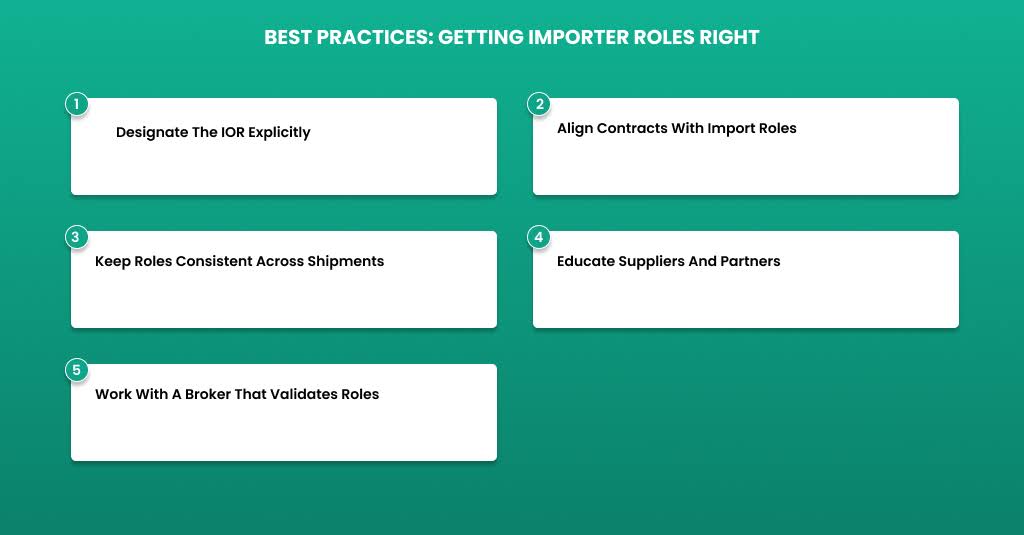
1. Designate the IOR Explicitly
Don’t assume.
Document who the IOR is before shipping.
2. Align Contracts with Import Roles
Ensure:
- Incoterms match importer responsibilities
- Payment terms don’t contradict declarations
3. Keep Roles Consistent Across Shipments
Changing IORs frequently increases audit risk.
4. Educate Suppliers and Partners
Suppliers often populate invoices incorrectly.
That error becomes your liability.
5. Work With a Broker That Validates Roles
A proper customs process checks:
- Who is declaring
- Who is paying
- Who is responsible
If you’re unsure where to start, this guide lays out a clean framework.
Conclusion
Importer roles aren’t just labels, they define who carries risk, who answers to CBP, and who pays when something goes wrong.
In today’s enforcement environment:
- Role confusion causes delays
- Incorrect IOR designation increases penalties
- Refund opportunities are lost
- Audits become harder to defend
Before your next shipment moves, make sure your importer roles are clearly defined and correctly documented. If you want to build an import structure that’s compliant from day one, start here.
FAQs
Is the consignee always the Importer of Record?
No. The consignee and IOR can be completely different parties.
Can a non-U.S. company be the IOR?
Yes. Non-Resident Importers can act as IORs if properly registered.
Who gets audited, the owner or the IOR?
The IOR. Ownership alone does not trigger audit responsibility.
Can marketplaces or couriers be the IOR?
Sometimes, but this often creates long-term compliance risks.
Does misidentifying the IOR delay shipments?
Yes. CBP may hold cargo until importer responsibility is clarified.